I am always puzzled why people can get very animated when you talk about solar panels, wind turbines, and other alternative energy sources that are not very cost effective. Puzzled because there are so many other things people can do, right now, to generate very significant savings at little or no cost.
Let's take the color of our roofs. A new study by researchers at the Lawrence Berkeley National Laboratory concludes that installing cooler roofs and pavements in cities has the potential to offset the heating effect of two years of worldwide carbon emissions. Put another way, Art Rosenfeld, a Berkeley Lab physicist, calculates that if all the flat roofs in cities in the tropical and temperate regions of the world were converted to white, the cooling effect would reduce carbon emissions by an amount equal to taking 300 million cars off the road for 20 years.
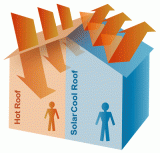
Installing a white roof instead of a darker-colored roof creates tremendous energy and environmental benefits. The white roof will keep the building cooler, meaning that its air-conditioning system will not use as much energy. That is why California requires a cool roof on any commercial buildings that have an air-conditioning units.
A white roof is also cooler for the rest of us outside the building. A dark-colored roof will absorb heat that is then carried into the air by the wind. This heat creates what is known as the urban heat island effect -- which explains in large part why cities are always hotter than the countryside.
The urban heat island heat effect takes on increased importance when we consider that more than 5 billion people, or 60% of the world's population, will live in cities by 2030. Many of these city dwellers will live in megacities with populations in excess of 10 million people. We must plan and design these cities carefully to avoid turning urban heat islands into urban heat ovens.
Energy Secretary Steven Chu has directed that his department install light-colored roofs on any new buildings or when replacing roofs on existing buildings. He has also sent a letter to all other federal department heads urging them to adopt the same policy. "Cool roofs are one of the quickest and lowest cost ways we can reduce our global carbon emissions and begin the hard work of slowing climate change," says Secretary Chu. "By demonstrating the benefits of cool roofs on our facilities, the federal government can lead the nation toward more sustainable business practices, while reducing the federal carbon footprint and saving money for taxpayers."
Secretary Chu's cool roofs initiative is one major step federal agencies are taking to comply with President Obama's Executive Order 13514 directing that the federal government greenhouse gas emissions be reduced by 28% over the next 10 years.
John Howley
Orlando, Florida
Let's take the color of our roofs. A new study by researchers at the Lawrence Berkeley National Laboratory concludes that installing cooler roofs and pavements in cities has the potential to offset the heating effect of two years of worldwide carbon emissions. Put another way, Art Rosenfeld, a Berkeley Lab physicist, calculates that if all the flat roofs in cities in the tropical and temperate regions of the world were converted to white, the cooling effect would reduce carbon emissions by an amount equal to taking 300 million cars off the road for 20 years.
Installing a white roof instead of a darker-colored roof creates tremendous energy and environmental benefits. The white roof will keep the building cooler, meaning that its air-conditioning system will not use as much energy. That is why California requires a cool roof on any commercial buildings that have an air-conditioning units.
A white roof is also cooler for the rest of us outside the building. A dark-colored roof will absorb heat that is then carried into the air by the wind. This heat creates what is known as the urban heat island effect -- which explains in large part why cities are always hotter than the countryside.
The urban heat island heat effect takes on increased importance when we consider that more than 5 billion people, or 60% of the world's population, will live in cities by 2030. Many of these city dwellers will live in megacities with populations in excess of 10 million people. We must plan and design these cities carefully to avoid turning urban heat islands into urban heat ovens.
Energy Secretary Steven Chu has directed that his department install light-colored roofs on any new buildings or when replacing roofs on existing buildings. He has also sent a letter to all other federal department heads urging them to adopt the same policy. "Cool roofs are one of the quickest and lowest cost ways we can reduce our global carbon emissions and begin the hard work of slowing climate change," says Secretary Chu. "By demonstrating the benefits of cool roofs on our facilities, the federal government can lead the nation toward more sustainable business practices, while reducing the federal carbon footprint and saving money for taxpayers."
Secretary Chu's cool roofs initiative is one major step federal agencies are taking to comply with President Obama's Executive Order 13514 directing that the federal government greenhouse gas emissions be reduced by 28% over the next 10 years.
John Howley
Orlando, Florida
 RSS Feed