When we think of the developing world, we often envision people living in rural areas with dirt roads and little infrastructure. That picture is real, but an equally real picture is millions of people living in cities. In fact, more than half the world's population currently lives in cities and that percentage is growing rapidly.
The growth rates of many cities in the developing world are astounding. Lagos, Nigeria had a population of about 300,000 in 1950. Today it is a megacity with an estimated population of 15 million people, and it is projected to have a population of 25 million people just five years from now.
The UN projects that more than 5 billion people, or 60% of the world's population, will live in cities by 2030. At least 10 megacities will be in Asia. Mumbai, India will lead that group with a projected population of 33 million people. Close behind will be Shanghai, China with a projected population of 27 million; Karachi, Pakistan with 26.5 million; Dhaka, Bangladesh with 26 million; and Jakarta, Indonesia with 24.9 million people.
The growth rates of many cities in the developing world are astounding. Lagos, Nigeria had a population of about 300,000 in 1950. Today it is a megacity with an estimated population of 15 million people, and it is projected to have a population of 25 million people just five years from now.
The UN projects that more than 5 billion people, or 60% of the world's population, will live in cities by 2030. At least 10 megacities will be in Asia. Mumbai, India will lead that group with a projected population of 33 million people. Close behind will be Shanghai, China with a projected population of 27 million; Karachi, Pakistan with 26.5 million; Dhaka, Bangladesh with 26 million; and Jakarta, Indonesia with 24.9 million people.
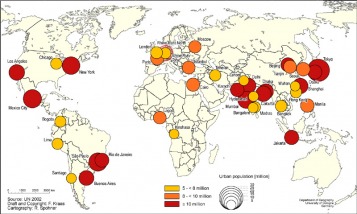
This UN map shows large urban populations as of the year 2000. Red dots indicate urban populations larger than 10 million people; Orange 8-10 million; Yellow 5-8 million.
In many areas, megacities will merge to form massive urban regions. Already more than 120 million people live in the tri-city region of Hong Kong, Shenhzen and Guangzhou in China. Greater Tokyo is already home to more than 35 million people -- more people than the entire population of Canada.
The explosive growth in urban populations will create tremendous pressures on food, water, waste treatment, and health care -- especially if, as projected, more than 2 billion people will be living in slums and shantytowns by 2030.
If we act responsibly, however, energy does not have to be a problem. We have the ability today to design, build and operate net-zero buildings in almost any climate. Net zero means that the building produces at least as much energy as it consumes. Simple techniques such as adequate insulation, positioning buildings, windows, roofs and landscaping to take advantage of sun and shade, climate-appropriate ceiling heights and fans, and dampers to control outside air flows can dramatically reduce the energy needs of buildings. Additional savings can be generated with other well-known technologies such as window films, geothermal heat pumps, and controls for lighting and HVAC systems.
Cities also offer great opportunities to reduce energy needs in transportation. Urban planners can design cities to encourage walking and bike riding. Mass transit systems can dramatically reduce the need for personal transport. Electric vehicles can shift energy consumption for transportation to renewable sources.
Much has been done already. The US Department of Energy and the National Renewable Energy Laboratory have developed the methods to design and construct net zero buildings in any climate. Local governments are incorporating LEED and other sustainable building standards in building codes. Auto makers are coming out with new all-electric models, and major retailers are planning to install recharging stations in their parking lots.
We can meet the energy needs of massive urban populations IF we acknowledge the problem, make plans, and take action now. But 2030 is not that far away. There is no time to waste.
John Howley
Orlando, Florida
The explosive growth in urban populations will create tremendous pressures on food, water, waste treatment, and health care -- especially if, as projected, more than 2 billion people will be living in slums and shantytowns by 2030.
If we act responsibly, however, energy does not have to be a problem. We have the ability today to design, build and operate net-zero buildings in almost any climate. Net zero means that the building produces at least as much energy as it consumes. Simple techniques such as adequate insulation, positioning buildings, windows, roofs and landscaping to take advantage of sun and shade, climate-appropriate ceiling heights and fans, and dampers to control outside air flows can dramatically reduce the energy needs of buildings. Additional savings can be generated with other well-known technologies such as window films, geothermal heat pumps, and controls for lighting and HVAC systems.
Cities also offer great opportunities to reduce energy needs in transportation. Urban planners can design cities to encourage walking and bike riding. Mass transit systems can dramatically reduce the need for personal transport. Electric vehicles can shift energy consumption for transportation to renewable sources.
Much has been done already. The US Department of Energy and the National Renewable Energy Laboratory have developed the methods to design and construct net zero buildings in any climate. Local governments are incorporating LEED and other sustainable building standards in building codes. Auto makers are coming out with new all-electric models, and major retailers are planning to install recharging stations in their parking lots.
We can meet the energy needs of massive urban populations IF we acknowledge the problem, make plans, and take action now. But 2030 is not that far away. There is no time to waste.
John Howley
Orlando, Florida
 RSS Feed